
In the operation of painting and coating lines, operating equipment continuously builds up paint and powder – racks, hooks, gratings and skids become coated with paint. To keep coating results reproducible, this equipment has to be completely stripped at regular intervals. Here we explain the processes and their fields of application.
ProcessThermal paint stripping (pyrolysis)
In thermal paint stripping – also referred to as pyrolysis or low-temperature pyrolysis – organic coatings are removed by heating the components in a furnace under an oxygen-reduced atmosphere in a controlled manner to around 400 to 450 °C. Under these conditions, liquid paints, powder coatings, cathodic dip-coating layers, plastics and comparable organic substances decompose and pass into the gas phase as pyrolysis gas. The reduced amount of oxygen prevents the parts from burning or distorting.
The pyrolysis gases produced are fed into a thermal afterburner, where they are converted almost completely into water vapour and carbon dioxide at approximately 850 °C. This keeps emissions within the statutory limits – entirely without aggressive chemicals and without open stripping baths. After cooling, only a fine ash layer remains on the components; it is subsequently removed by blasting (for example with corundum or glass beads), high-pressure water jetting or steam cleaning. On request, the parts can then be passivated or preserved.
The process is particularly suitable for heat-resistant, bulky metal parts with heavy paint build-up and is usually more economical there than chemical stripping.
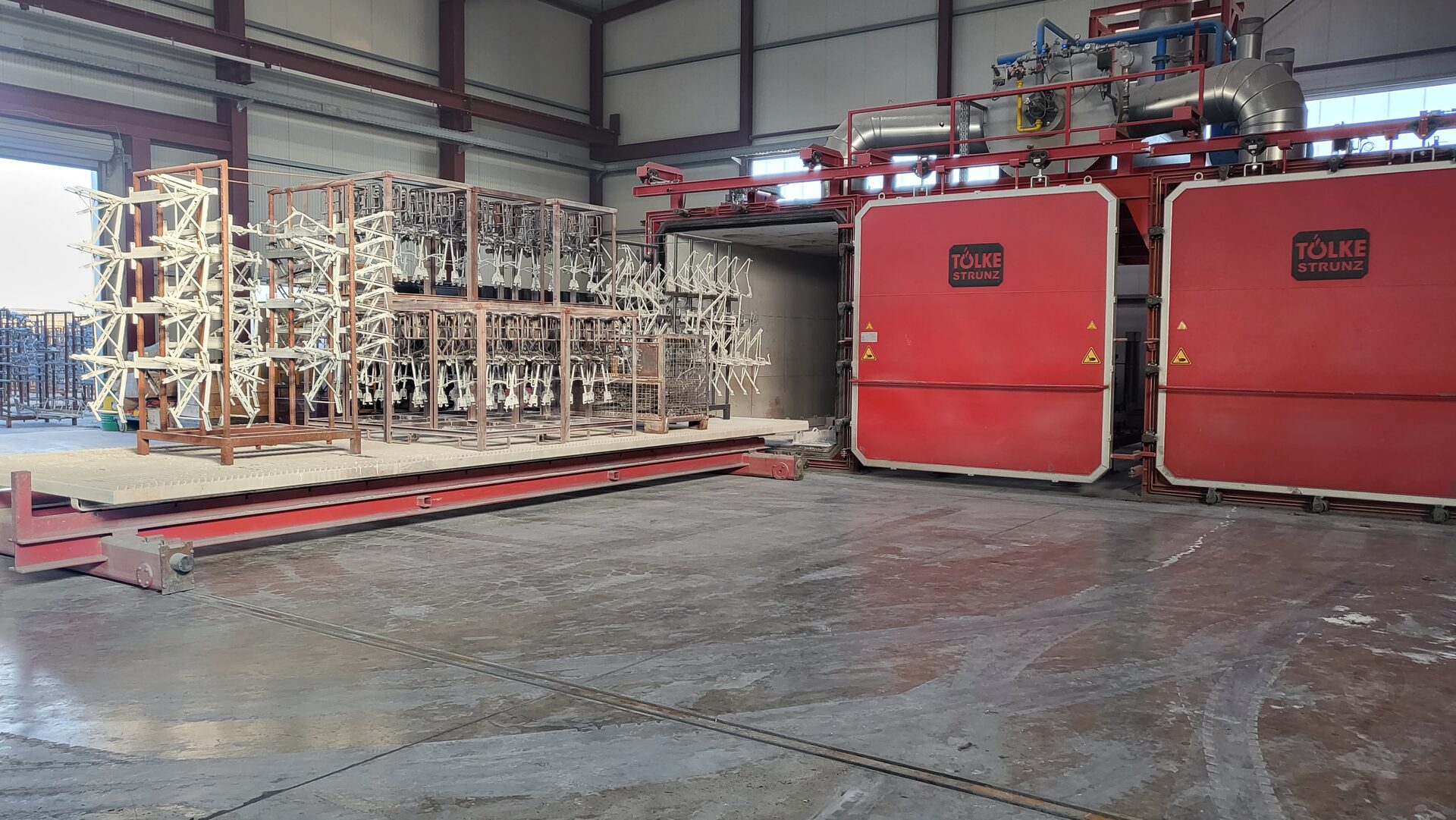
Cleaning & stripping of coating racks
Racks, workpiece carriers, paint hooks, crossbars and fixtures carry the workpieces through the coating line. With every pass, some paint or powder adheres to them – the paint build-up increases steadily. This has a direct effect on process quality: in electrostatic powder coating, the fixtures must remain electrically conductive so that earthing and charge build-up work correctly. A thick paint layer insulates, impairs powder adhesion and leads to fluctuating coating thicknesses and rejects. This can be booked as a service via thermal cleaning of tools and plant components as well as thermal stripping of coated components.
Regular, cyclical stripping of the operating equipment restores electrical contact, ensures consistent coating thicknesses and extends the service life of the racks, as they are reused many times. Incorrectly or faultily coated parts can also be recovered in this way instead of being scrapped.
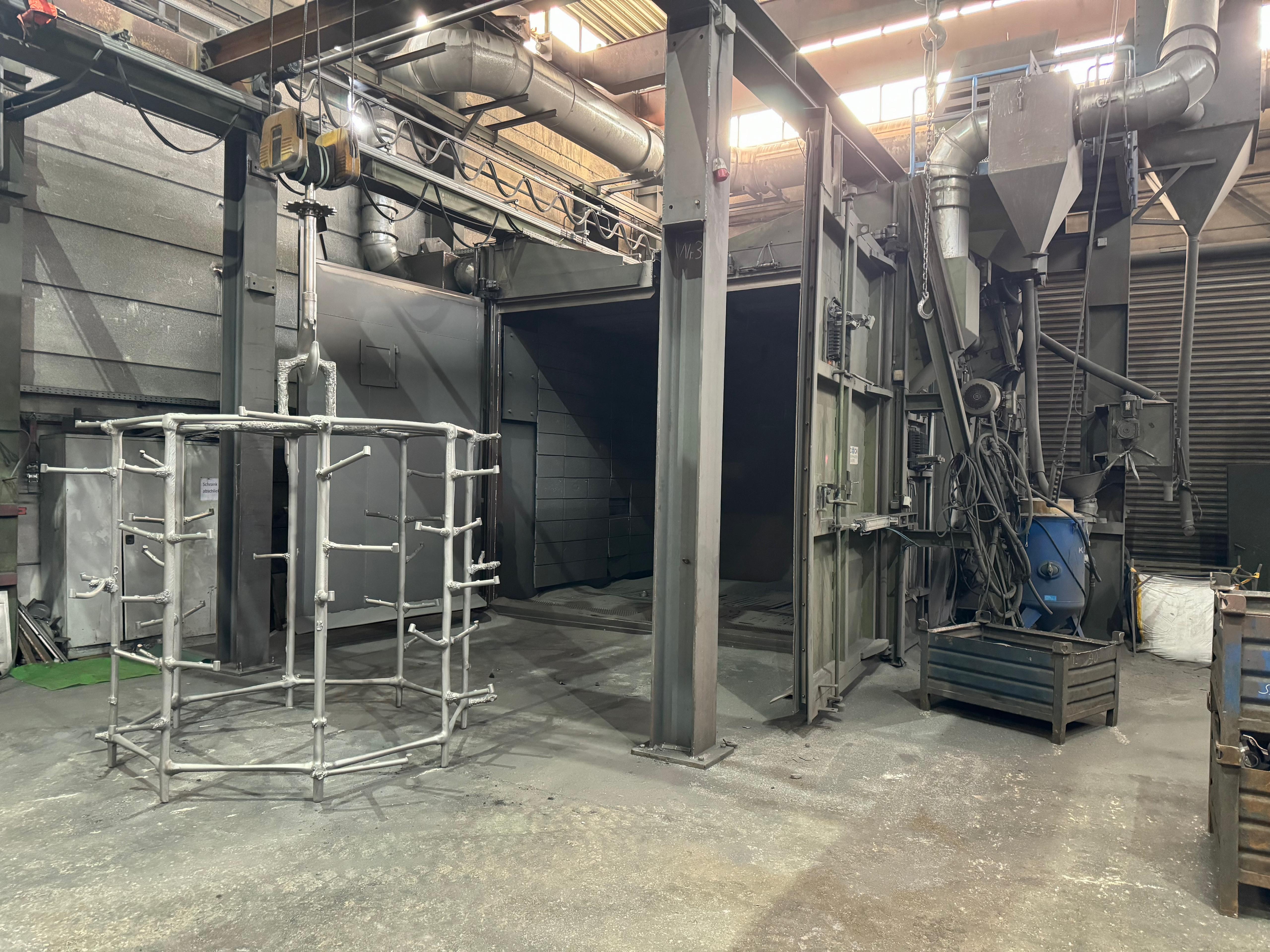
Gratings, skids & conveying equipment
Grating cleaning. Gratings from paint booths, filter floors and spray stations become clogged with overspray during operation. Blocked gratings impede the air flow in the booth and impair painting quality. Thermal stripping fully opens up the grating again – the gratings can be put back into service instead of being replaced.
Skid cleaning. In automated paint lines – above all in the automotive industry – bodies and components travel through the plant on so-called skids (transport frames). Over many cycles, these skids also accumulate paint build-up that impairs dimensional accuracy, seating and electrical contact. Periodic stripping – thermal or chemical – keeps conveying and painting processes precise and free of faults. The same applies to other conveying equipment such as hangers, fixtures and jigs.
Tools from the plastics industry
Extruder screws, nozzles, tools, hot runners and breaker plates are freed of polymer and paint residues without leaving any residue.
Electric motors
Stripping of stators and components for refurbishment and reuse.
Heat exchangers & filters
Caked-up components are cleaned gently and completely.
Heat-resistant components
Springs, magnets, rotary tables and separator vessels are suitable for thermal cleaning.
GuidanceWhich process is the right one?
The choice depends on the material, the coating thickness and the heat resistance. The processes are often combined – for example thermal stripping followed by blasting.