
← All services Surface Technology · OT.06

Chemical paint stripping

Gentle, residue-free paint removal – including high-volume parts and temperature-sensitive workpieces.

Chemical paint stripping is the right choice when components have to retain their dimensions and their structure. Because the paint layer is dissolved rather than heated, no distortion occurs – which makes the process particularly suitable for thin-walled, dimensionally critical and temperature-sensitive workpieces made of aluminium, zinc or die castings.

The process in detail

In chemical paint stripping, organic coatings are removed in a controlled manner without attacking the base material. Depending on the task, we work in a stripping bath or with a spray process:

  • Dip stripping – The workpiece is placed on a workpiece carrier into a heated, covered bath that is circulated continuously. The medium therefore washes around the component on all sides and also reaches cavities, profiles and complex geometries in full. Depending on the paint build-up, the condition of the bath and the material, the process takes around 2 to 10 hours.
  • Spray stripping – A non-foaming medium is sprayed onto the surface in a targeted manner and then cleaned off with high-pressure water. This works over large areas and selectively, requires less medium and is economical when only the visible surface has to be stripped.

The medium is selected according to the paint and the material: alkaline at 75–95 °C for steel parts, acidic at 80–85 °C for aluminium profiles, engine parts and aluminium wheels, solvent-based at 80–150 °C where the surface must not be attacked. For sensitive materials we use mild agents that are gentle on the metal. Stripping is followed by rinsing and, where necessary, neutralising or passivating; a final glass bead blasting removes any remaining residues. The differences between the stripping bath and the spray process are explained in the article Dip and spray stripping compared; for equipment in particular, see Stripping paint hooks, hangers and conveyor chains.

Suitable components and materials

Highly alkaline media are suitable for steel, but not for aluminium or zinc – for non-ferrous metals we choose acidic media accordingly. Continuously cast aluminium does not darken in the process. The process is regarded as the most important means of removing powder coatings from steel and aluminium wheels as well as from profiles, windows and components made of non-ferrous metals.

  • Hangers, crossbars and workpiece carriers from coating lines
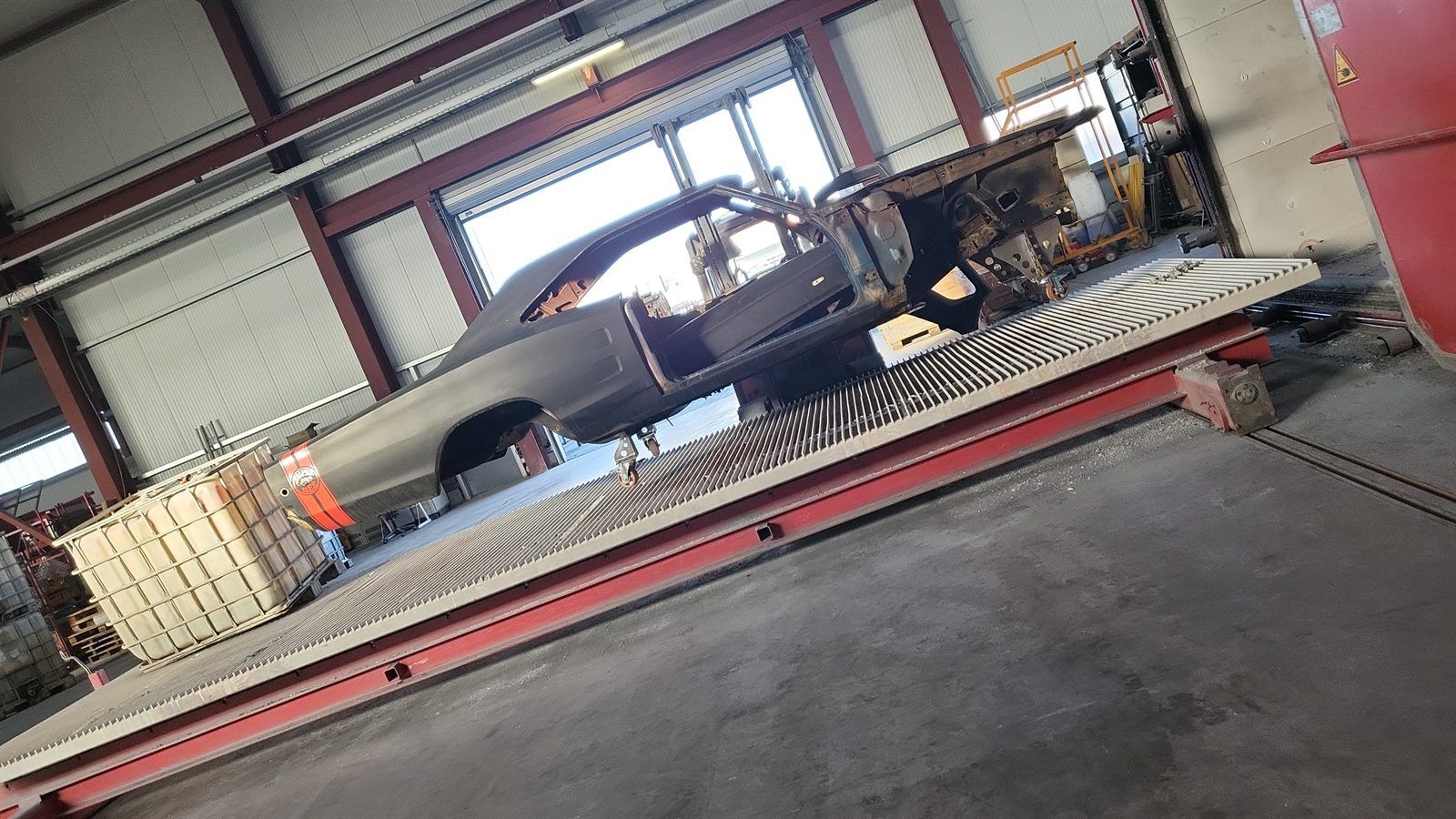
  • Vehicle bodies and vehicle components
  • High-volume and small parts in large quantities
  • Temperature-sensitive components

Robust, temperature-resistant parts with thick paint build-ups are stripped more economically by thermal paint stripping in the pyrolysis furnace instead.

Quality assurance and documentation

Process control is the quality lever: bath temperature and bath condition determine whether a coating is removed completely and whether the material remains undamaged. We check the result on the component – bright, evenly stripped surfaces with no residual paint in cavities and profiles. On request we document the reprocessing and, for recurring series, inspect an initial sample beforehand.

Key facts

Process
chemical, dip process
Property
gentle on the material, residue-free
Suitability
including sensitive workpieces
Result
bright, coatable surface
Completely stripped vehicle body
FAQ

Frequently asked questions

How long does stripping in the bath take?

Depending on the paint build-up, the condition of the bath and the material, around 2 to 10 hours.

Which materials is the process suitable for?

Particularly for temperature-sensitive and dimensionally critical parts made of aluminium, zinc or die castings. For steel parts we use alkaline media, for non-ferrous metals acidic ones – highly alkaline media are not suitable for aluminium or zinc.

Does the component distort in the process?

No. The paint layer is dissolved and not heated, so there is no thermal loading and no distortion. Tolerances and surfaces are retained.

Are cavities and profiles reached as well?

Yes. In the stripping bath the component is washed around on all sides, so that cavities, profiles and complex geometries are also reached in full.

What happens after stripping?

The part is rinsed and, where necessary, neutralised or passivated. A final glass bead blasting removes any remaining residues and prepares the surface for recoating.

Related processes
From our knowledge base

Components to be stripped?

Tell us the material, the coating and the quantity – we will select the gentlest process.

Send enquiry