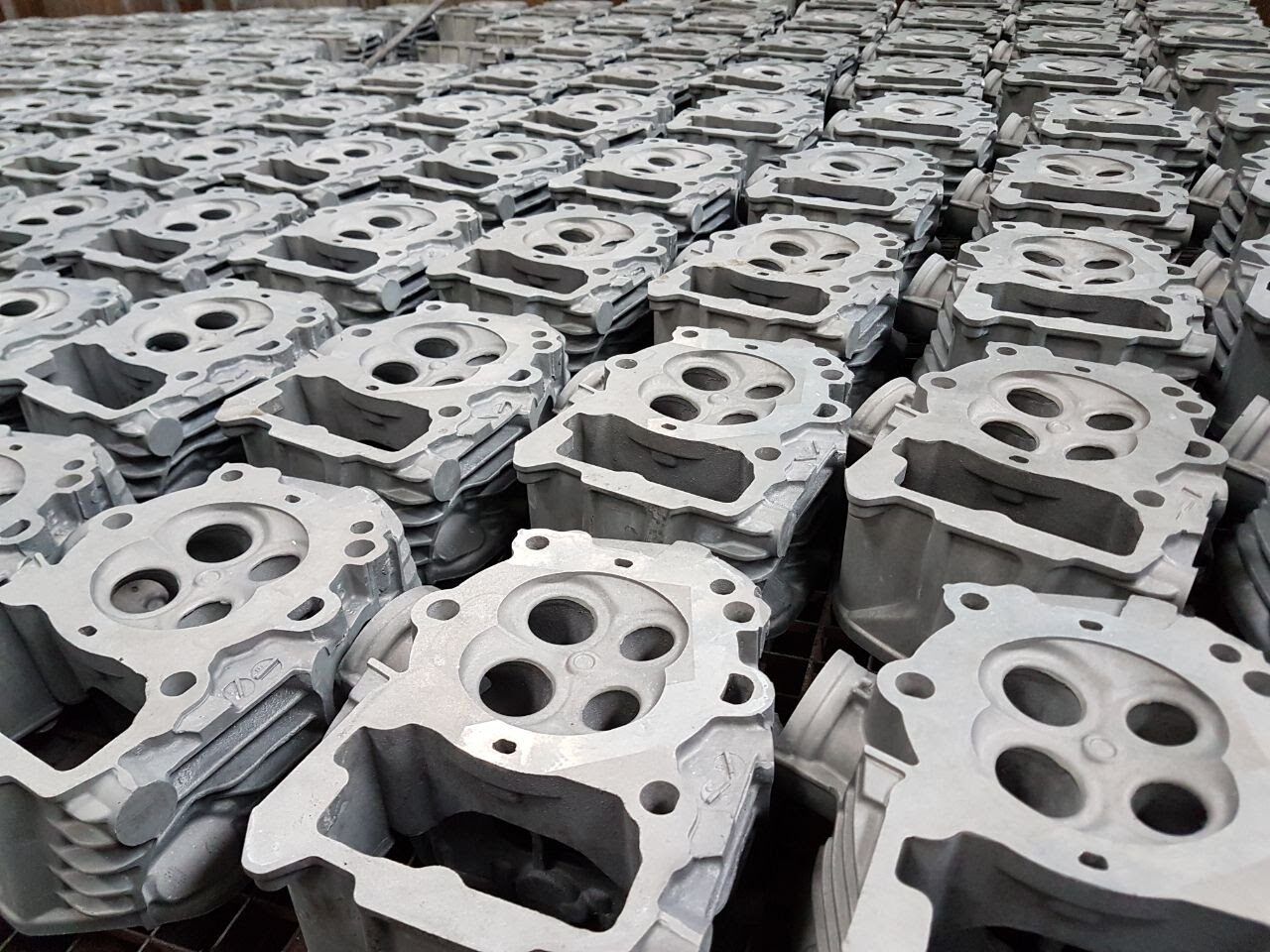
For us, sandblasting is not a cleaning step on the side but the measurable basis of every coating that follows. Suppliers from mechanical engineering, metalworking and steel construction commission it in order to bring raw parts, welded assemblies or used components into a defined, coating-ready condition – from single parts to series production.
The process in detail
In sandblasting, we mechanically remove rust, scale, old coatings and contamination and establish a defined surface condition. What matters is not only cleanliness but the controlled roughness: it determines how well a subsequent powder, paint or sprayed metal layer will adhere. We select blasting media, grain size and pressure to suit the material and the required surface preparation grade – and verify the result by measurement.
The choice of blasting media controls what happens to the component:
- Steel grit and steel shot – powerful descaling and cleaning of steel and cast iron
- Stainless steel shot – for stainless steels and aluminium
- Corundum – sharp-edged roughening for maximum adhesion
- Glass beads – matt finishing and compacting of the surface
Depending on the task, this allows us to achieve sand and core removal on castings, descaling and derusting, the breaking of burrs and sharp edges, defined roughening as an adhesion base, or an even, decorative matt finish. Our specialist article on blasting media and their effect on cast surfaces examines which media are suitable for which material.
Suitable components and materials
We blast steel, cast iron, stainless steel and aluminium. Because these materials react differently to the blasting process, we adapt the procedure to each material so that the surface is optimally prepared without damaging or unacceptably deforming the component. We keep sensitive geometries and dimensional tolerances in view throughout.
- Preparation prior to powder coating, industrial painting and thermal zinc spraying
- Derusting and descaling of steel and cast components
- Roughening for defined adhesion in demanding coating systems
- Cleaning of series parts and single items through to large components
A large-volume blast room is available for bulky large components; high unit volumes run more economically via continuous shot blasting on the series line.
Quality assurance and documentation
For us, surface quality is a measured value, not a visual check: the roughness is recorded by measurement and checked against the specification, and the surface preparation grade assessed in accordance with ISO 8501-1 – we achieve bare-metal substrates up to Sa 2½ to Sa 3. On request, we carry out an initial sample inspection before series release and document the test values in digital reports that can be traced for initial samples, series deliveries and audits.
Key facts
- Materials
- steel, cast iron, stainless steel, aluminium
- Batch sizes
- from single parts to high-volume series
- Quality
- roughness controlled by measurement
- Next step
- can be transferred directly to coating/painting