
← All services Surface Technology · OT.03

Powder coating

Solvent-free, reproducible coating in all RAL and NCS shades – with high corrosion and chemical resistance.

Powder coating is the process of choice whenever metal components are to be protected durably and given a defined colour at the same time – from a single machine-building frame to recurring series for suppliers to the metal and automotive industries. Because the powder coating material is applied and cured solvent-free, a single operation produces a closed film that is mechanically robust and weather-resistant.

The process in detail

The process runs in four steps that build on one another. What decides the result is not the application itself but the pre-treatment: on a surface that has not been properly prepared, even perfectly applied powder will not adhere permanently.

  • Pre-treatment – oil, grease, scale and rust are removed, for example by degreasing or blasting. The dry, activated surface ensures adhesion and corrosion protection.
  • Application – the powder coating material is charged electrostatically by a corona or tribo gun and sprayed onto the earthed workpiece. It also adheres in areas that are difficult to reach; overspray is extracted and reused.
  • Curing – in the oven the powder melts at around 160–200 °C, flows out and cross-links to form a closed film. Depending on the powder and the wall thickness, this takes about 10–30 minutes.
  • Inspection – after controlled cooling, coating thickness, adhesion and surface quality are checked.

The type of powder and its formulation allow us to control resistance and appearance: polyester for components exposed to weathering and UV outdoors, epoxy for high chemical resistance indoors, epoxy-polyester as a robust indoor coating. We supply colour shades to RAL and NCS as well as special and effect colours such as metallic or micaceous iron, in gloss levels from matt through satin to high gloss, smooth or textured. The full sequence is described in our specialist article on the electrostatic coating process in four steps.

Suitable components and materials

Steel, aluminium as well as hot-dip galvanised and stainless steels can be coated – from single parts to high-volume series. Typical items are frames and add-on parts, sections and sheet metal parts, visible and functional components from mechanical engineering and metal fabrication, vehicle parts as well as components for façades and furniture. Components for outdoor use or chemically loaded environments benefit particularly from the closed film with good edge coverage.

Existing old coatings are no obstacle: we remove them beforehand by chemical paint stripping in the stripping bath or thermal paint stripping in the pyrolysis furnace so that the component enters the coating process clean.

Quality assurance and documentation

Consistent quality comes from controlled processes and inspection of the finished part. Pre-treatment baths and oven temperatures are monitored, and the result is measured on the component. We check coating thickness, gloss level and colour shade on every order; on request we document the values for your incoming goods inspection.

  • Coating thickness – typically 60–120 µm, measured in accordance with DIN EN ISO 2360 / 2178
  • Adhesion – cross-cut test in accordance with ISO 2409
  • Gloss level – measurement in accordance with ISO 2813
  • Corrosion protection – salt spray test on a test panel
  • Quality guidelines – GSB, Qualicoat and QIB as a point of reference

Within the HAASE Group, PICTUM Oberflächentechnik works in accordance with ISO 9001.

Key facts

Colours
all RAL and NCS shades, matt to gloss
Coating thickness
typically 60–120 µm
Materials
steel, aluminium, galvanised and stainless steels
Batch sizes
from single parts to high-volume series
Testing
coating thickness, gloss, colour shade, adhesion
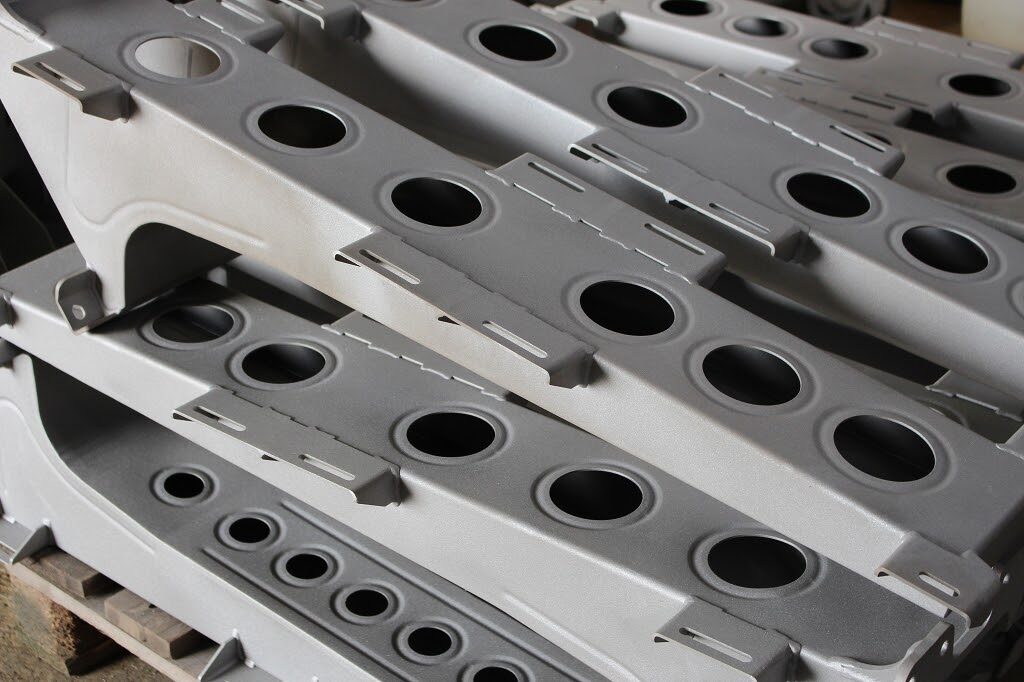
Powder-coated sections and sheet metal parts
FAQ

Frequently asked questions

From what quantity do you coat?

From single parts to high-volume series – small batches and sample series are just as possible as recurring series orders.

Do the components have to be delivered pre-treated?

No. Pre-treatment is part of our service. We also remove any existing old coatings beforehand by chemical or thermal paint stripping.

Which materials can be powder coated?

Steel, aluminium as well as hot-dip galvanised and stainless steels.

What documentation do I receive for the coating?

Coating thickness, gloss level and colour shade are tested and, on request, documented for your incoming goods inspection.

How large may the components be?

Tell us the dimensions and the weight of the component – we will check whether it can be accommodated in our line and come back to you with an assessment.

Related processes
From our knowledge base

A series to be coated?

Tell us the colour shade, quantity and component size – we will prepare a quote for you.

Send enquiry