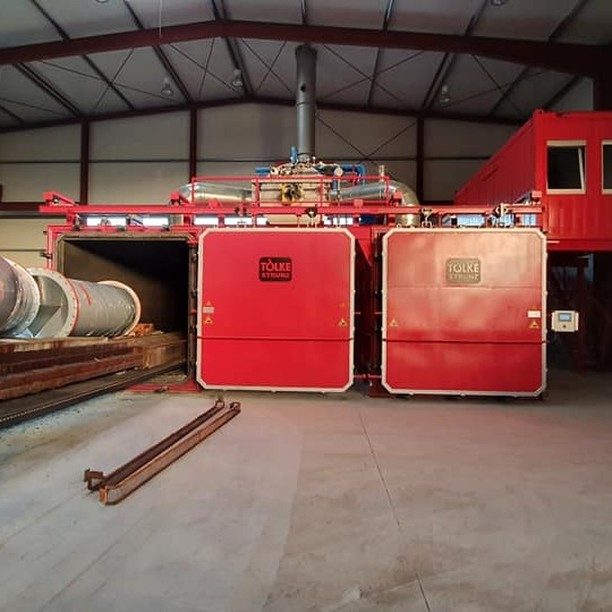
Thermal paint stripping is the most economical route when robust metal parts carry thick, multi-layer old coatings. Coating companies use it to have their hangers and workpiece carriers reprocessed at regular intervals, and manufacturers use it to save incorrectly coated parts – entirely without aggressive chemicals and without open stripping baths.
The process in detail
In thermal paint stripping – also known as pyrolysis – the components are heated in a furnace under controlled conditions to around 400 to 450 °C in an oxygen-reduced atmosphere. Under these conditions, wet paints, powder coatings, cathodic dip coatings and comparable organic substances decompose and pass into the gas phase as pyrolysis gas. The reduced amount of oxygen is decisive here: it prevents the parts from burning or distorting.
The resulting pyrolysis gases are fed into a thermal afterburner and converted there at around 850 °C almost completely into water vapour and carbon dioxide, so that pollutant emissions remain within the statutory limits. After cooling, only a fine ash layer remains on the component, which is then removed by blasting – with corundum or glass beads, for example – or by high-pressure or steam jetting. On request, the parts can afterwards be passivated or preserved. How pyrolysis works and what happens to the gases produced is described in the article on thermal paint stripping in the pyrolysis furnace; for stripping equipment, see hangers, crossbars and chains with paint build-up.
Suitable components and materials
The process is suitable for temperature-resistant, bulky metal parts with heavy paint build-up, and there it is usually more economical than chemical stripping. It is not suitable, however, for thin-walled, galvanised or dimensionally critical aluminium parts – these we strip using chemical paint stripping without thermal loading.
- Hangers, crossbars and workpiece carriers from the coating line
- Metal components with thick, multi-layer coatings
- Reprocessing instead of buying new
- Preparation for a new coating
Quality assurance and documentation
The process is made reproducible by the controlled furnace atmosphere: temperature control and oxygen content are monitored so that the coating is decomposed completely without damaging the component. We check the result on the component after the ash has been removed – a bright surface that can be recoated or processed further straight away.
For equipment from powder coating lines, the bare contact point is the actual quality characteristic. Cured paint acts as an electrical insulator: hooks and workpiece carriers with heavy paint build-up no longer offer a bare contact point, charging deteriorates and coating thicknesses fluctuate. Regular paint stripping restores a low earth resistance, ensures uniform coating thicknesses and reduces rejects. At the same time, without paint build-up the workpieces fit exactly into their fixtures again – a quality factor in its own right in automated systems. Because racks can be reused many times in this way, regular reprocessing is usually more economical than disposal and new purchase.
Key facts
- Temperature
- pyrolysis, around 450 °C
- Result
- residue-free, bright
- Suitability
- robust metal components
- Process
- controlled furnace atmosphere