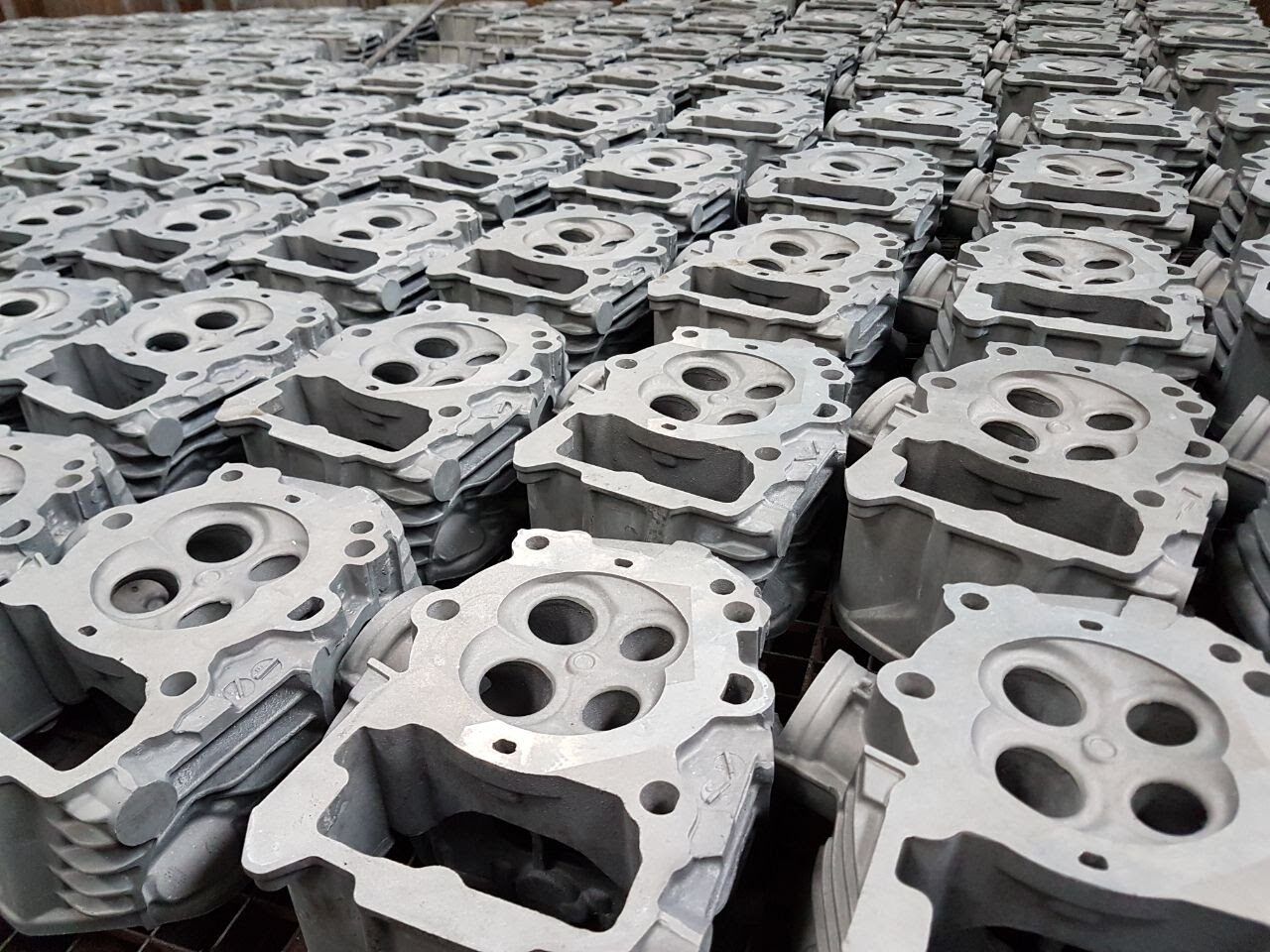
When it is not a single component but an entire batch that has to be prepared to a consistent quality, continuous shot blasting is the most economical process. Steel and metal fabrication companies use it to derust and descale sheets, sections and beams in a single pass before coating or painting.
The process in detail
In continuous shot blasting, the components pass through the blasting machine continuously on a conveyor belt. Several blast wheels – rotating turbines – accelerate the blasting media purely mechanically and without compressed air, treating the surface simultaneously from defined angles. This produces consistent results across large unit volumes, with a considerably higher throughput than manual blasting.
Our continuous blasting line processes parts up to 2400 mm working width. Surface preparation grade and roughness are set via the blasting media, media flow rate and belt speed and remain constant across the entire batch. In total we operate five large blasting machines of different designs – roller conveyor and overhead rail machines for flat parts and for parts to be treated on all sides respectively, plus a tumble belt machine on which bulk goods and small parts are gently turned over and blasted all round. How wheel blasting machines are built and which machine types are distinguished is described in the specialist article wheel blasting in detail.
Suitable components and materials
The process is particularly suitable for flat and long parts made of steel and cast iron – sheets, plates, sections, tubes and flat welded assemblies. The overhead rail system also allows bulky castings to be treated on all sides, while the tumble belt handles large quantities of small parts.
- Series derusting of sheets, sections and beams
- Flat welded assemblies prior to coating or painting
- Preparation of steel and metal fabrication components
- An even surface as the basis for reproducible coating systems
Here, too, we control the result through the choice of blasting media: steel grit and steel shot for powerful descaling and cleaning of steel and cast iron, stainless steel shot for stainless steels and aluminium, corundum for sharp-edged roughening, glass beads for matt finishing and compacting. Depending on the task, this produces different results – from sand and core removal on freshly cast parts through descaling and derusting to the deburring of sharp edges or the strengthening of highly stressed components by shot peening, which increases fatigue strength through the compressive residual stress introduced.
Single items, bulky large components and sensitive materials are handled instead by sandblasting with blasting media selected to suit the material.
Quality assurance and documentation
Because the blasting media, media flow rate and belt speed are kept constant across the entire batch, the result is reproducible rather than dependent on the day. The roughness is monitored by measurement and the surface preparation grade assessed in accordance with ISO 8501-1 – up to Sa 2½ to Sa 3 for bare-metal substrates. On request, we inspect an initial sample beforehand and document the characteristic values digitally so that they remain traceable for series deliveries and audits.
Key facts
- Working width
- up to 2400 mm
- Suitability
- sheets, sections, beams, welded parts
- Strength
- high throughput at constant quality
- Next step
- directly into coating/painting